
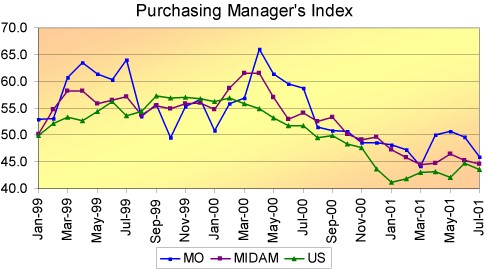
Missouri's Purchasing Managers Index (PMI) score decreased to 46.0 in July from June's score of 49.6, according to the monthly Mid-American Business Conditions Survey, conducted by Creighton University, Omaha, NE.
Economists consider the index, which measures such factors as new orders, production, supplier delivery times, backlogs, inventories, prices, employment, import orders and exports, a key economic indicator. Typically, a score greater than 50 indicates an expansionary economy, while a score below 50 forecasts a sluggish economy for the next three to six months. Despite July's dip, Missouri's PMI index continues to run higher than the regional and national averages.
The results of the survey indicate that businesses in Missouri reported a significant drop in overall economic activity in July. A lack of new hiring and rising unemployment was offset by increases in hours worked. Very weak conditions over the past several months in the state's manufacturing sector are now being felt by businesses in the service sector.
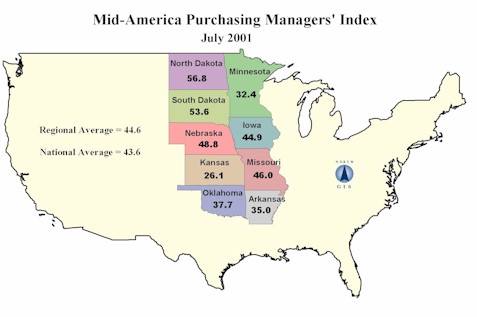
The state's PMI score placed it fourth among the nine states included in the Mid-America region. North Dakota posted the region's highest PMI rate with 56.8, while Kansas posted the region's lowest score with an anemic 26.1. Other states in the regional survey included: Arkansas, 35.0; South Dakota, 53.6; Nebraska, 48.8; Iowa, 44.9; Oklahoma, 37.7; and Minnesota, 32.4.
Overall, the average for the Mid-America Region was 44.6, down from June's 45.3. This is the second-lowest reading of the past seven years. Researchers at Creighton see no immediate end to the current economic downturn in the region, as rising energy costs, declining exports, and reductions in business investment have worked to lower the confidence of purchasing managers.
The national PMI score for July was 43.6, down from June's 44.7. It was the 12th consecutive month that the national PMI was below 50. While the national index has experienced an upward trend over the last few months, manufacturing will remain "mired in recession", according to economists at Economy.com.
