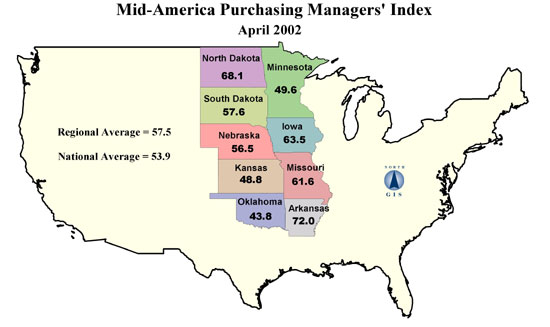
Missouri's Purchasing Manager's Index (PMI) continued to climb in April. The state's PMI score for April rose to 61.6 from 59.4 in March, according to the monthly Mid-American Business Conditions Survey, conducted by Creighton University, Omaha, NE. This marks the fifth consecutive increase in Missouri's PMI score, and the third straight month above the critical 50 mark.
Economists consider the index, which measures such factors as new orders, production, supplier delivery times, backlogs, inventories, prices, employment, import orders and exports, a key economic indicator. Typically, a score greater than 50 indicates an expansionary economy, while a score below 50 forecasts a sluggish economy for the next three to six months.
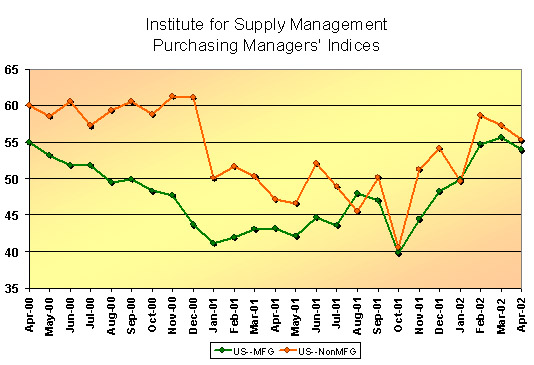
The national PMI for manufacturing industries decreased slightly
in April to 53.9 from 55.6 in March. Despite the decrease, April was
the third consecutive month that the U.S. score was above the
expansionary level of 50. The nation's PMI for non-manufacturing
industries was 55.3 in April, a decrease from March. Though the pace
has decreased from the previous month, a score of 55.3 indicates
continued healthy expansion for the services side of the economy.
Note: The national purchasing manager's indices are produced by
the Institute for Supply Management, formerly the Purchasing
Management Association.
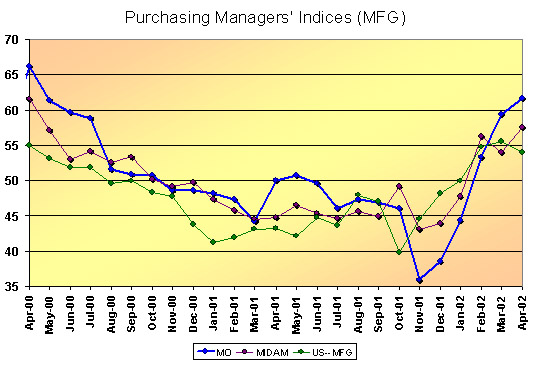
Missouri's April composite score topped 50 for the third straight month. Increases in new orders (68.2), production (67.5), employment (56.1), and inventories (52.3) boosted the state's score.
Missouri's PMI score placed it fourth among the nine states included in the Mid-America region. Arkansas boasted the region's highest score, 72.0, a 5.7-point increase over March. Oklahoma posted the region's lowest April score, 43.8. Other states in the regional survey included: North Dakota, 68.1; Iowa, 63.5; South Dakota, 57.6; Nebraska, 56.5; Minnesota, 49.6; and Kansas, 48.8.
Overall, the average for the Mid-America Region was 57.5, up from March's 54.0, the highest level since April 2000. Additionally, the Mid-America Region new jobs index rose above 50 for the first time since November 2000 to 50.2.