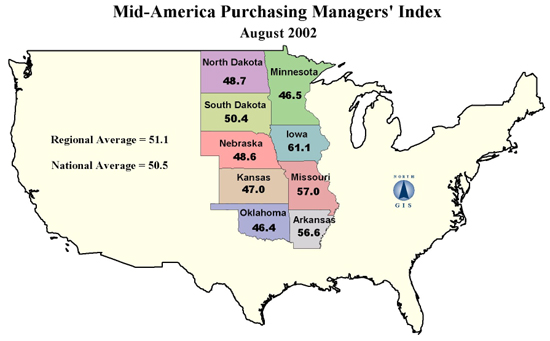
Missouri's Purchasing Manager's Index (PMI) declined in August for the second straight month. The state's PMI score fell 4.8 points from 61.8 to 57.0 in August, according to the monthly Mid-American Business Conditions Survey, conducted by Creighton University, Omaha, NE. However, August does mark the seventh straight month that Missouri's score has remained above the critical 50 mark.
Economists consider the index, which measures such factors as new orders, production, supplier delivery times, backlogs, inventories, prices, employment, import orders and exports, a key economic indicator. Typically, a score greater than 50 indicates an expansionary economy, while a score below 50 forecasts a sluggish economy for the next three to six months.
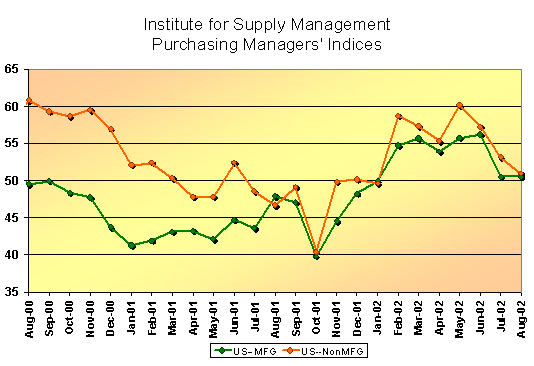
The national PMI for manufacturing industries held steady in
August at 50.5. August's score fell below economist's
expectations and indicates manufacturing activity expanded at a very
modest rate. The nation's PMI for non-manufacturing industries
declined in August, dropping from 53.1 to 50.9. In considering both
the manufacturing and non-manufacturing reports, each index shows a
U.S. economy that is recovering quite slowly and is full of
uncertainty.
Note: The national purchasing manager's indices are produced by
the Institute for Supply Management, formerly the Purchasing
Management Association.
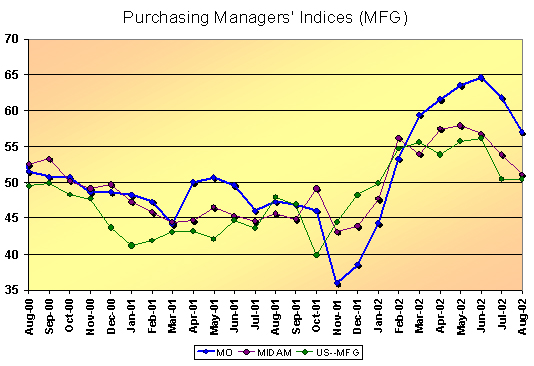
Missouri's August composite score was above 50 for the seventh straight month, with solid readings in production (62.9) and new orders (60.9).
Missouri's PMI score placed it second among the nine states included in the Mid-America region. Only four states reported expansion in August. Iowa had the region's highest score, 61.1, a slight decrease from July. Oklahoma had the region's lowest score at 46.4. Other states in the regional survey included: Arkansas, 56.6; South Dakota, 50.4; North Dakota, 48.7; Nebraska, 48.6; Kansas, 47.0; and Minnesota, 46.5.
Overall, the average for the Mid-America Region was 51.1 in August, down from July's 53.9. Drought conditions are considered a primary cause for the drop in the Mid-America index.