
Names: conventional long form: Republic of Rwanda conventional short form: Rwanda local long form: Republika y'u Rwanda local short form: Rwanda former: Ruanda, German East Africa
Capital City: Kigali
Population: 8,648,248 note: estimates for this country explicitly take into account the effects of excess mortality due to AIDS; this can result in lower life expectancy, higher infant mortality and death rates, lower population and growth rates, and changes in the distribution of population by age and sex than would otherwise be expected (July 2006 est.)
GDP Per Capita: $1,600 (2006 est.)
Currency: Rwandan franc (RWF)
Languages: Kinyarwanda (official) universal Bantu vernacular, French (official), English (official), Kiswahili (Swahili) used in commercial centers
Total Area: total: 26,338 sq km land: 24,948 sq km water: 1,390 sq km slightly smaller than Maryland
Region: Africa
Industries: cement, agricultural products, small-scale beverages, soap, furniture, shoes, plastic goods, textiles, cigarettes
Agriculture: coffee, tea, pyrethrum (insecticide made from chrysanthemums), bananas, beans, sorghum, potatoes; livestock
Resources: gold, cassiterite (tin ore), wolframite (tungsten ore), methane, hydropower, arable land
Labor Force:
4.6 million (2000)
agriculture: 90% industry and services: 10%
Exports:
$135.4 million f.o.b. (2006 est.)
coffee, tea, hides, tin ore
Imports:
$390.4 million f.o.b. (2006 est.)
foodstuffs, machinery and equipment, steel, petroleum products, cement and construction material
Overview:
Rwanda is a poor rural country with about 90% of the population engaged in (mainly subsistence) agriculture. It is the most densely populated country in Africa and is landlocked with few natural resources and minimal industry. Primary foreign exchange earners are coffee and tea. The 1994 genocide decimated Rwanda's fragile economic base, severely impoverished the population, particularly women, and eroded the country's ability to attract private and external investment. However, Rwanda has made substantial progress in stabilizing and rehabilitating its economy to pre-1994 levels, although poverty levels are higher now. GDP has rebounded and inflation has been curbed. Despite Rwanda's fertile ecosystem, food production often does not keep pace with population growth, requiring food imports. Rwanda continues to receive substantial aid money and obtained IMF-World Bank Heavily Indebted Poor Country (HIPC) initiative debt relief in 2005. Kigali's high defense expenditures have caused tension between the government and international donors and lending agencies. Rwanda obtained debt relief from the IMF and World Bank in 2006. Rwanda also received Millennium Challenge Account Threshold status in 2006. Energy shortages, instability in neighboring states, and lack of adequate transportation linkages to other countries continue to handicap growth.
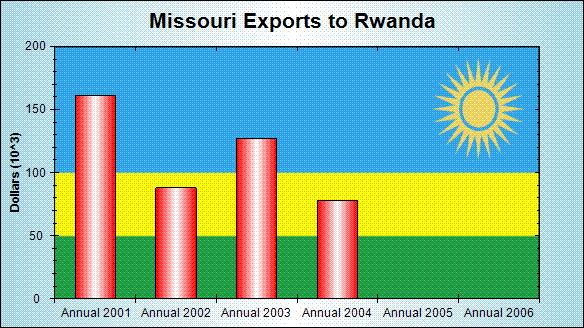
In 2007 Missouri exported $19,605 in goods to Rwanda. This ranks Rwanda 132nd among the 223 international buyers of Missouri goods. Missouri exports to Rwanda increased from the previous year by $19,605 a change of NA. State exports to Rwanda have decreased over the last 5 years by $68,220 a change of -77.68%. Missouri exports account for .00%. of all 2007 US exports to Rwanda
| NAICS Industry | Annual | ||||||
|---|---|---|---|---|---|---|---|
| 2002 | 2003 | 2004 | 2005 | 2006 | 2007 | ||
| 000 - Total All Industries MO | 87,825 | 126,958 | 77,521 | NA | NA | 19,605 | |
| 000 - Total All Industries US | 10,185,014 | 7,918,639 | 11,199,108 | 10,534,162 | 11,684,654 | 16,050,053 | |