

Names: conventional long form: Republic of Albania conventional short form: Albania local long form: Republika e Shqiperise local short form: Shqiperia former: People's Socialist Republic of Albania
Capital City: Tirana (Tirane)
Population: 3,581,655 (July 2006 est.)
GDP Per Capita: $5,600 (2006 est.)
Currency: lek (ALL) note: the plural of lek is leke
Languages: Albanian (official - derived from Tosk dialect), Greek, Vlach, Romani, Slavic dialects
Total Area: total: 28,748 sq km land: 27,398 sq km water: 1,350 sq km slightly smaller than Maryland
Region: Europe
Industries: food processing, textiles and clothing; lumber, oil, cement, chemicals, mining, basic metals, hydropower
Agriculture: wheat, corn, potatoes, vegetables, fruits, sugar beets, grapes; meat, dairy products
Resources: petroleum, natural gas, coal, bauxite, chromite, copper, iron ore, nickel, salt, timber, hydropower
Labor Force:
1.09 million (not including 352,000 emigrant workers) (2004 est.)
agriculture: 58% industry: 19% services: 23% (2004 est.)
Exports:
$763.2 million f.o.b. (2006 est.)
textiles and footwear; asphalt, metals and metallic ores, crude oil; vegetables, fruits, tobacco
Imports:
$2.901 billion f.o.b. (2006 est.)
machinery and equipment, foodstuffs, textiles, chemicals
Overview:
Lagging behind its Balkan neighbors, Albania is making the difficult transition to a more modern open-market economy. The government has taken measures to curb violent crime and reduce the large grey economy. The economy is bolstered by annual remittances from abroad of $600-$800 million, mostly from Albanians residing in Greece and Italy; this helps offset the towering trade deficit. Agriculture, which accounts for about one-quarter of GDP, is held back because of lack of modern equipment, unclear property rights, and the prevalence of small, inefficient plots of land. Energy shortages and antiquated and inadequate infrastructure contribute to Albania's poor business environment, which make it difficult to attract and sustain foreign investment. The planned construction of a new thermal power plant near Vlore and improved transmission and distribution facilities eventually will help relieve the energy shortages. Also, the government is moving slowly to improve the poor national road and rail network, a long-standing barrier to sustained economic growth. On the positive side: growth was strong in 2003-06 and inflation is low and stable.
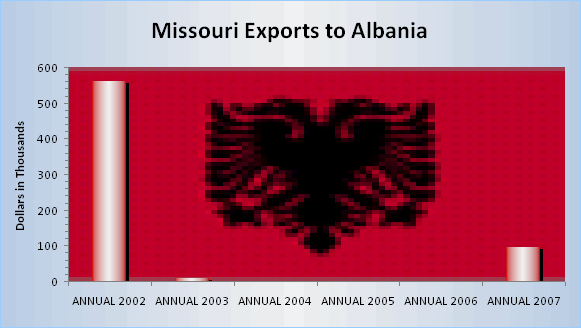
In 2007 Missouri exported $95,023 in goods to Albania. This ranks Albania 142nd among the 223 international buyers of Missouri goods. Missouri exports to Albania increased from the previous year by $95,023 a change of NA. State exports to Albania have decreased over the last 5 years by $465,240 a change of -83.04%. Missouri exports account for .00%. of all 2007 US exports to Albania.
| NAICS Industry | Annual | ||||||
|---|---|---|---|---|---|---|---|
| 2002 | 2003 | 2004 | 2005 | 2006 | 2007 | ||
| 000 - Total All Industries MO | 560,263 | 7,622 | NA | NA | NA | 95,023 | |
| 000 - Total All Industries US | 15,021,250 | 9,703,198 | 20,094,075 | 18,483,925 | 27,631,235 | 33,965,115 | |