
Missouri Personal Income Growth Outpaces Nation's
Personal income in Missouri increased 1.1 percent, from $181.57 billion to $183.54 billion, from the fourth quarter of 2004 to the first quarter of 2005, says a Bureau of Economic Analysis (BEA) news release. This outpaced the national average of 0.7 percent. The rate of personal income growth in Missouri was less than half that of the preceding quarter's 2.8 percent.
Utah had the largest jump in personal income from the fourth quarter of 2004 to the first quarter of 2005, at 2.1 percent; Washington experienced a 7.7% decline due in part to weak Microsoft Corporation dividends, says the report. Property income in Washington also declined 39 percent after rising 66 percent in the fourth quarter.
Missouri ranked No. 21 nationally in personal income growth. Here's how Missouri's neighbors ranked:
- Arkansas, No. 8, a 1.4 percent increase
- Illinois, 38, 0.7 percent
- Iowa, 41, 0.6 percent
- Kansas, 37, 0.7 percent
- Kentucky, 20, 1.1 percent
- Nebraska, 32, 0.8 percent
- Oklahoma, 16, 1.2 percent
- Tennessee, 19, 1.1 percent
Net earnings, defined as the sum of wage and salary disbursements, supplements to wages and salaries, and proprietors' income, increased 1.9 percent in Missouri from the fourth quarter of 2004 to the first quarter of 2005. Transfer payments -- payments to individuals and to nonprofit institutions by federal, state, and local governments and by businesses -- rose 2.9 percent. Dividends, interest and rent, the third major component of personal income, fell 3.5 percent.
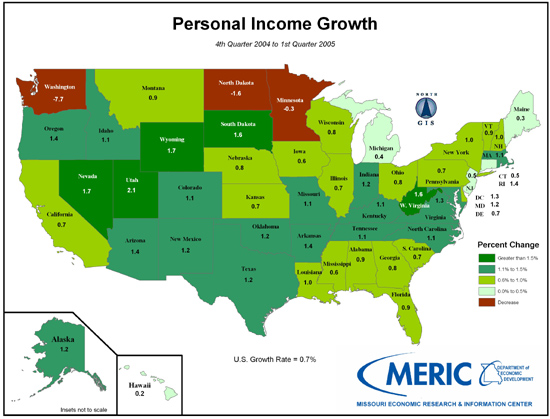
All but one BEA industry category rose in income from quarter to quarter. Here are the leading Missouri industry percentage increases:
Durable goods manufacturing, .10 percent
Wholesale trade, .11 percent
Retail trade, .15 percent
Transportation and warehousing, .09 percent
Information, .11 percent
Finance and insurance, .15 percent
Professional and technical services, .13 percent
Management of companies and enterprises, .38 percent
Health care and social assistance, .18 percent
Federal civilian government, .22 percent
Only administrative and waste services fell: a .04 decline.
View the complete BEA report at: http://www.bea.doc.gov/bea/newsrel/SQPINewsRelease.htm
